Sunday, 8 March 2020

thai pork stirfry

from a youtube streetfood video, https://www.youtube.com/watch?v=q8wTzjbGgnE

the dish is great, the recipe is just a mnemoic. watch the video.

ingredients: (just use the correct quantities for however many people you have, there is no magic going on here, i didn't measure, watch the video to get a feel for it if you're unsure)

  • a bunch of rice
  • minced pork
  • little red chillies, chopped
  • garlic, chopped
  • red onion, chopped
  • garlic sprouts or spring onion, the green bit is the important bit, don't throw that away, it's the best bit
  • thick oyster sauce
  • rice vinegar
  • soy sauce
  • thai fish sauce
  • oil
  • salt
  • sugar
  • msg
  • thai sweet basil
  • egg
  • thin cucumber
  • nori or sth


things to do, in order


  1. hot pan
  2. hot oil
  3. mince
  4. chopy + fry it up
  5. add mixed chopped garlic and red onion
  6. add chopped red chillis LITTLE THAI ONES
  7. mix & fry
  8. chop in some veg, garlic sprouts ideally, maybe spring onion i guess
  9. then goes in MYSTERIOUS SAUCE oyster sauce, thick one not the insipid thin one
  10. then a dash of fish sauce, a dash of soy sauce
  11. bit more oil; then some rice vinegar
  12. tip in a scoop of salt, sugar, msg (the last is important if you're not going to do it then why are you cooking this? it'll be a sad sad dish)
  13. slap on the rice
  14. then go in a bunch of thai sweet basil leaves (not stalks, wrong texture, and don't chop them neither)
  15. fold it over a bunch of times so it's combined
  16. paddle it out in a bowl in a nice dome, don't squidge it, obviously, just build it like that
  17. ok good? now new pan or whatever
  18. best w curve edges, and you gotta get that oil deep, so it should be a little pan. or you know maybe A WOK
  19. get it hot hot hot
  20. put in an egg. don't let it get attached to the bottom, move it around gently after liek 15 seconds or whatever
  21. scoop hot oil onto the egg while cooking, a lot, all the time
  22. keep it mobile
  23. then serve it on top of the rice!
  24. also go back in time and chop up some seaweed nori as a side
  25. slice up a cool little cucumber/gherkin to serve

Friday, 10 March 2017

Hao You Niu Rou, 蚝油牛肉

Cows in china say "niuuuu". Hao you is oyster sauce. Rou is flesh. Let's go. This is the style I preferred in Nanjing, a bit Sichuan I guess, probably?

Ingredients

  • 400g beef (short rib cuts are great if you can be bothered, any old beef is cool though)
  • 3 scallions, white portion and cut into 1-2cm sections
  • Some thin slices of ginger
  • 2-3 sweet peppers, chopped into chunks, thumb-size chunks (too small and all that chopstick work picking them up won't yield enough food!)
  • 1-2 chillies, sliced (say 3mm per slice) and chopped a bit after that
  • Some oil (not olive, smoke point lower than a beefy cat, i.e. loowww)
  • Sesame oil and fine-slivered carrot or red pepper for garnish


  • Marinade:
    • 1 tablespoon soy sauce
    • 1 tablespoon rice wine
    • 1 teaspoon sugar (any fine kind that dissolve instantly, i.e. avoid big-grain demarara)
    • 2 teaspoons potato / corn starch
  • Sauce:
    • 1 teaspoon MSG else it will all be for nought
    • 1 tablespoon rice wine (if you have none, you can add a little extra wine vinegar)
    • 1 tablespoon soy sauce
    • 1 teaspoon rice wine vinegar
    • 2 tablespoons chicken or beef stock, or even vegetable bouillon from powder
    • 2 tablespoons Oyster Sauce

If you're going to eat this with a noodle replacement like spaghetti squash, prep that now and get it in (45 mins @190C / 380F).

Slice the meat across the grain, 1/8” thick, into small strips, approximately 3/4” by 2” or so. Combine the meat with the marinade ingredients, toss it up, and set aside for at least a half hour.

Now do prep - chopping and all that. Luckily there's no garlic here!

When you've finished that, make the sauce in a little bowl or a cup; mix it up a bit. It'll settle but that's OK.

If you're going to eat this alongside rice, put that on now.

Heat 4 tbsps of oil in wok until it's really warm and almost smoking. Stir fry the beef for one or two minutes, allowing it to rest occasionally on the sides of the wok, until it begins to brown; remove with a slotted spoon and set aside.

Reheat wok to medium high, and as soon as it begins to smoke, add the scallion and ginger slices and quickly stir fry until onion just begins to brown on the edges, then toss in the peppers and chillies, frying for 30 seconds or so.

Stir up your sauce with a chopstick or something, then add it. Toss the mixture in the pan until it is boiling vigorously, then, as it begins to reduce, add back the sliced meat. Mix the whole, and when sauce has reduced enough to coat the ingredients without too much puddling in the bottom of the wok, pour onto a small platter and garnish with sesame oil and slivered vegetables for appearance.

NOW EAT

Monday, 11 April 2016

Vegetarian chili

Serves.. 6? Or so?

Prep 15 mins
Cooking 1 hour


Ingredients

  • 1 tablespoon olive oil 
  • 1/2 medium onion, chopped 
  • 2 bay leaves 
  • 1 teaspoon ground cumin 
  • 2 tablespoons dried oregano 
  • 1 tablespoon salt 
  • 2 stalks celery, chopped 
  • 2 green bell peppers, chopped 
  • 2 jalapeno peppers, chopped 
  • 3 cloves garlic, chopped 
  • 2 (4 ounce) cans chopped green chile peppers, drained 
  • 2 (300g) packages vegetarian burger crumbles / 300g rasp total
  • 3 (28 ounce) cans whole peeled tomatoes, crushed 
  • 1/4 cup chili powder 
  • 1 tablespoon ground black pepper 
  • 1 440ml can kidney beans, drained 
  • 1 440ml can garbanzo beans (chickpeas), drained 
  • 1 440ml can black beans 
Directions

  1. Heat the olive oil in a large pot over medium heat. Stir in the onion, and season with bay leaves, cumin, oregano, and salt. Cook and stir until onion is tender
  2. Mix in the celery, green bell peppers, jalapeno peppers, garlic, and green chile peppers. When vegetables are heated through, mix in the vegetarian burger crumbles. Reduce heat to low, cover pot, and simmer 5 minutes.
  3. Mix the tomatoes into the pot. Season chili with chili powder and pepper. Stir in the kidney beans, garbanzo beans, and black beans. Bring to a boil, reduce heat to low, and simmer 45 minutes.
Based on http://allrecipes.com/recipe/72508/the-best-vegetarian-chili-in-the-world/ .

Ratatouille

Based on http://www.tastingtable.com/cook/recipes/how-to-make-ratatouille-french-ratatouille-recipe-eggplant-ratatouille-recipe .

Yield: 4 servings
Prep Time: 35 minutes; aubergines will sweat while you do the rest of the prep
Cook Time: 1 hour
Total Time: 1 hour and 20 minutes, plus 30 minutes draining time

INGREDIENTS

  • 2 large aubergines, peeled if you like, cut into half to one-inch pieces
  • 1½ teaspoons kosher salt, divided, plus more to taste
  • ½ cup olive oil total
  • 1 large courgette, sliced into ¼-inch-thick rounds
  • 2 pints Sun Gold or cherry tomatoes, divided (eighthed whole tomatoes can be a substitute, at a pinch)
  • 4 thyme sprigs
  • 3 summer savory sprigs (optional)
  • 1 bay leaf
  • 2 medium yellow (i.e. normal) onions, cut into ½-inch dice
  • 1 red bell pepper - stemmed, seeded and chopped
  • 2 garlic cloves, thinly sliced
  • Pinch crushed red pepper flakes (optional)
  • 1 cup loosely packed basil leaves, torn
  • 1 tablespoon finely chopped flat-leaf parsley

DIRECTIONS

  1. Toss the eggplant with 1 teaspoon of the salt and allow to drain in a colander for 30 minutes. Pat dry with a paper towel and set aside.
  2. In a large Dutch oven or heavy-bottomed pot over medium-high heat, add 2 tablespoons of the olive oil. When the oil is hot but not smoking, add the eggplant and cook, stirring often, until golden, 8 to 10 minutes. If the eggplant absorbs all the oil and begins to stick to the bottom, add more oil as needed. Remove the eggplant and set aside in a medium bowl. Add 2 more tablespoons of the olive oil to the pot and cook the zucchini until golden but not completely tender, 2 to 4 minutes. Remove and transfer to the bowl with the eggplant. Do not wash out the pot.
  3. Using your hands, crush half of the tomatoes and season them with ½ teaspoon of the salt and set aside.
  4. Using kitchen twine, tie the thyme, savory and bay leaf sprigs together. In the same pot, heat the remaining ¼ cup of the oil. Add the onions and herb bundle, and cook until soft and translucent, 8 to 10 minutes. 
  5. Add the bell pepper and cook, stirring occasionally, until the onions and red pepper are very soft, 14 to 16 minutes. 
  6. Add the garlic and red pepper flakes and cook until fragrant, 1 to 2 minutes. 
  7. Add the crushed share of the tomatoes, then reduce the heat to medium low and cook until the tomatoes are very soft and the flavors have melded together, 8 to 10 minutes. 
  8. Add the pre-cooked aubergine and courgette and the remaining tomatoes, and stir 2 to 3 times to combine. Season with salt, cover and reduce the heat to low. Cook until all the vegetables have softened, 12 to 15 minutes. 
  9. Remove from the heat, adjust the seasoning as needed and discard the herb bundle. Top with the basil and parsley, and serve.

Wednesday, 7 December 2011

Steak au Poivre and Bananas Foster

There are recipes all over the web, and I don't have a favorite website to link to, but the basic run down (if you don't know) goes like this:

Steak:

Steak (they say Filet, but I use a NY Strip on the regular. Coat liberally in cracked black pepper. Heat pan. HOT! Add gracious amount of butter. Add steak. Sear. Flip and repeat. Remove steak. Add Brandy. Deglaze. Ignite Brandy (WOOSH!). Add heavy cream. Stir till thick. return steak, flip to coat. Ready.

Bananas Foster:

Peel and cut bananans lengthwise, then on the bias widthise into 1-2" pieces. Place a bunch of butter and brown sugar in a skillet and heat till liquidy caramel forms. Add banans, toss to coat. Add some rum (vanilla or banana flavored works well). Ignite (WOOSH!) Burn off alcohol. Spoon bananas over vanilla ice cream. Serve. Like I said, that's from memory, but recipes are basically the same. They are seriously so easy, I don't even measure anything anymore. And they are always a hit (especially with my lady friend). You make the steak, maybe some garlic mashed and steamed broccoli on the side. Then after dinner, you chat with her/him from the kitchen while you whip up the Fosters (which takes abotu 8 minutes, start to finish) and bring out a bowl of that? They will be unable to resist you. Have fun cookin'

Wednesday, 30 November 2011

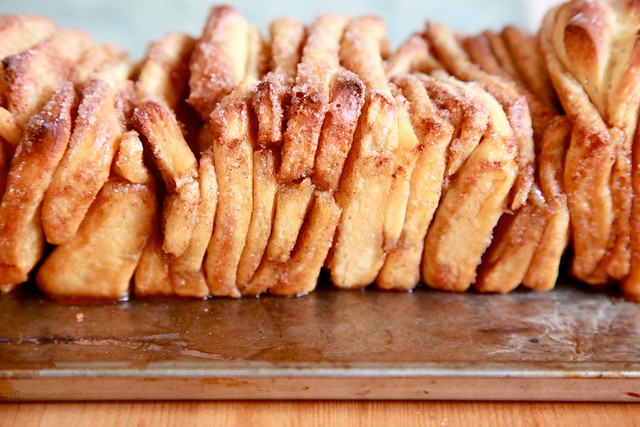
Cinnamon Sugar Pull-Apart Bread

From Joy the Baker Makes: one 9x5x3-inch loaf For the Dough: 2 3/4 cups plus 2 tablespoons all-purpose flour 1/4 cup granulated sugar 2 1/4 teaspoons (1 envelope) active dry yeast 1/2 teaspoon salt 2 ounces unsalted butter 1/3 cup whole milk 1/4 cup water 2 large eggs, at room temperature 1 teaspoon pure vanilla extract For the Filling: 1 cup granulated sugar 2 teaspoons ground cinnamon 1/2 teaspoon fresh ground nutmeg 2 ounces unsalted butter, melted until browned In a large mixing bowl (I used just the bowl of my stand mixer) whisk together 2 cups flour, sugar, yeast, and salt. Set aside. Whisk together eggs and set aside. In a small saucepan, melt together milk and butter until butter has just melted. Remove from the heat and add water and vanilla extract. Let mixture stand for a minute or two, or until the mixture registers 115 to 125 degrees F. Pour the milk mixture into the dry ingredients and mix with a spatula. Add the eggs and stir the mixture until the eggs are incorporated into the batter. The eggs will feel soupy and it’ll seem like the dough and the eggs are never going to come together. Keep stirring. Add the remaining 3/4 cup of flour and stir with the spatula for about 2 minutes. The mixture will be sticky. That’s just right. Place the dough is a large, greased bowl. Cover with plastic wrap and a clean kitchen towel. Place in a warm space and allow to rest until doubled in size, about 1 hour. *The dough can be risen until doubled in size, then refrigerated overnight for use in the morning. If you’re using this method, just let the dough rest on the counter for 30 minutes before following the roll-out directions below. While the dough rises, whisk together the sugar, cinnamon and nutmeg for the filling. Set aside. Melt 2 ounces of butter until browned. Set aside. Grease and flour a 9x5x3-inch loaf pan. Set that aside too. Deflate the risen dough and knead about 2 tablespoons of flour into the dough. Cover with a clean kitchen towel and let rest for 5 minutes. On a lightly floured work surface, use a rolling pin to roll the dough out. The dough should be 12-inches tall and about 20-inches long. If you can’t get the dough to 20-inches long… that’s okay. Just roll it as large as the dough will go. Use a pastry brush to spread melted butter across all of the dough. Sprinkle with all of the sugar and cinnamon mixture. It might seem like a lot of sugar. Seriously? Just go for it. Slice the dough vertically, into six equal-sized strips. Stack the strips on top of one another and slice the stack into six equal slices once again. You’ll have six stacks of six squares. Layer the dough squares in the loaf pan like a flip-book. Place a kitchen towel over the loaf pan and allow in a warm place for 30 to 45 minutes or until almost doubled in size. Place a rack in the center of the oven and preheat to 350 degrees F. Place loaf in the oven and bake for 30 to 35 minutes, until the top is very golden brown. The top may be lightly browned, but the center may still be raw. A nice, dark, golden brown will ensure that the center is cooked as well. Remove from the oven and allow to rest for 20 to 30 minutes. Run a butter knife around the edges of the pan to loosen the bread and invert onto a clean board. Place a cake stand or cake plate on top of the upside down loaf, and carefully invert so it’s right side up. Serve warm with coffee or tea. I think this bread is best served the day it’s made, but it can also we wrapped and kept at room temperature for up to 2 days.

Monday, 8 November 2010

Black pudding scotch eggs

After scoffing some great black pudding scotch eggs at Sheffield's 40th ale festival, I thought I'd try and make my own. I read seven or eight different recipes, and settled on something based on Hugh Fearnley-Whittingstall's basic scotch egg recipe. After this, I collected black pudding from a local butcher and also in sausage form from a delicatessen. The sausage form black pudding wasn't nearly as good; it's been sealed and boiled for durability, and this really impacted flavour - the butcher's square pudding was redder, squidgier, and had a much more rounded and noticeable flavour.

I made seven or eight eggs, measuring the ratio of meat in the mixture each time. There were at least four tasters, including me, James Walmesley, Steven Turner, Matthew Wintle. We settled on the recipe below.


Scotch eggs are the sort of thing you might not consider making yourself, but they're really not difficult. DIY means you can use a good, organic sausagemeat, and season it the way you like. Kids will love making these, though a grown-up should do the deep frying. Serves four.

  • 5 large tasty eggs, not from caged birds, something with flavour
  • 320g organic pork sausagemeat, or fresh minced shoulder
  • A few sage leaves, finely chopped, or failing that, half a spring onion (again finely chopped)
  • A good pinch of ground mace or nutmeg
  • 3 teaspoons Cayenne pepper (very important; give up if you don't have this)
  • Salt and freshly ground pepper
  • A mixture of 1 part peanut oil, 2 parts sunflower oil for deep frying. Chinese supermarket is good for extra-cheap peanut oil.
  • 3 tablespoons plain flour
  • 100g white breadcrumbs (at least a day old, or you can buy them pre-made)
  • 160g fresh, unboiled unskinned black pudding - or the closest to this you can get

Make sure the eggs are at room temperature. Bring a large pan of water to the boil, lower in four eggs and simmer for ten minutes after you've reached a good boil; we want very cooked eggs! Take them out of the water when they're done. When the eggs are cool enough to handle, peel them.

Add to the sausagemeat the sage, mace and cayenne, along with plenty of salt and pepper, and mix well with your hands. Break up the black pudding over this mixture and keep kneading it in, bit by bit. Then, divide the mixture into eight equal pieces (about 60 grams each) and shape each piece into a flat patty.

Take two patties and use to encase one egg, moulding the meat smoothly around the egg and making sure it's sealed all over. Make sure you really mix up the joins - any seams will split when you're cooking. Repeat with the others.

Pour the oil mixture into a deep pan (10cm / 4 inches at least) pan to a depth of at least 7cm and bring up to 170C (or until a cube of white bread, when dropped in, turns light golden brown in about one minute).

Spread the flour on a plate. Beat the remaining egg in a shallow dish. Spread the breadcrumbs on another plate. When the oil is up to temperature, dust each sausagemeat-encased egg in a little flour, then dip it in beaten egg and roll it in breadcrumbs. Lower one by one into the hot oil and fry for eight to 10 minutes, turning from time to time, until deep golden brown all over. If you don't turn them, they won't cook evenly, and they'll split.

Drain on kitchen paper and serve hot! If you plan a larger batch, be sure to change the oil every so often.

Here's a picture of a really meaty and delicious plain scotch egg from the above recipe, to get you motivated!

Monday, 1 June 2009

Marshmallows

Ingredients:
  • 9 sheets sheets leaf gelatine, 
  • 450g Sugar
  • 1 tbsp liquid glucose
  • 200 ml water, 
  • 2 large egg whites, 
  • 1 tsp vanilla extract
  • icing sugar
  • cornflour
  • Strawberries, to serve
Recipe
  1. Lightly oil a shallow baking tray, about 30 x 20cm and dust it with sieved icing sugar and cornflour.
  2. Soak the gelatine in 140ml cold water. 
  3. Put the sugar, glucose and water into a heavy-based pan. Bring to the boil and continue cooking for about 12-15 minutes until the mixture reaches 127C on a sugar thermometer. 
  4. When the syrup is up to temperature, carefully slide in the softened gelatine sheets and their soaking water. The syrup will bubble up so take care not to burn yourself. Pour the syrup into a metal jug. 
  5. Whisk the egg whites until stiff, preferably with an electric whisk in a mixing bowl. Continue whisking while pouring in the hot syrup from the jug. The mixture will become shiny and start to thicken. Add the vanilla extract and continue whisking for about 5-10 minutes, until the mixture is stiff and thick enough to hold its shape on the whisk. 
  6. Spoon the mixture into the prepared tin and smooth with a wet palette knife if necessary. 
  7. Leave for at least 1 hour to set. 
  8. Dust the work surface with icing sugar and cornflour. Loosen the marshmallow around the sides of the tray with a palette knife, and then turn it out on to the dusted surface. Cut into squares and roll in the sugar and cornflour. Leave to dry a little on a wire rack. 
  9. To serve: carefully place the marshmallows onto skewers, alternating with hulled strawberries. 
  10. Store the marshmallows in an airtight container. 

Tuesday, 14 April 2009

Della Rocca

This three-milk cheese was particularly good (ewe, goat and cow)

Sunday, 1 March 2009

Crunchy bread with artichokes

Simply top with peppers, pate, olives and artichoke slices, using olive oil to stick it all together.

Thursday, 12 February 2009

Æbleskiver

Danish aebleskiver with currant jelly

Tuesday, 10 February 2009

Monday, 12 January 2009

Hazelnut meringue sandwich

Filled with raspberry coulis and cream, and topped with fresh raspberries.

Saturday, 10 January 2009

Chocolate painted leaves

Melt some cooking chocolate, and paint it onto the underside of a leaf. Don't use dead or decaying leaves from the ground - get it from a tree. Place into the fridge on a tray (chocolate-side up), and gently peel the leaf off after two hours. Voila!

Wednesday, 17 December 2008

Mince pies

Tangy filling of mincemeat, redcurrants and apple.

Monday, 11 August 2008

Pork Pie Recipe

serves 10-12, or more! 20cm springform cake tin required filling:
  • 1kg pork shoulder, cut into 5mm cubes
  • 250g fresh pork belly, minced (or fatty sausage meat)
  • 250g salt pork, pancetta or streaky bacon, finely chopped
  • 12 sage leaves, finely chopped
  • Leaves from 2 good sprigs of thyme, chopped
  • 1 teaspoon salt
  • 1 teaspoon coarse black pepper
  • 1/2 teaspoon ground mace
  • good pinch of cayenne pepper
  • 1 bay leaf
  • 250ml good pork stock that will set to jelly
hot water crust:
  • 100g lard, diced
  • 100g butter, diced
  • 200ml water
  • 550g plain flour
  • 1 1/2 teaspoons salt
  • 2 eggs, beaten, plus 1 egg to glaze
the hot water crust pastry

Make the hot water crust pastry first. Put the lard, butter and water in a saucepan and heat gently until melted; do not let it boil. Put the flour and salt in a mixing bowl. Make a dip in the centre and add the beaten eggs, stirring them gently around with a knife so they are half mixed with the flour. Pour in the melted fat and water and mix together to form a soft dough; add up to 50ml extra warm water if it is too dry. Knead gently, adding more flour if it is too sticky to handle. Wrap in clingfilm and chill for one hour.

For the filling, mix all the meats with the herbs, salt and seasonings (except the bay leaf), so they are thoroughly combined.

pie construction and setting

Now assemble the pie. Cut off a generous quarter of the pastry and keep in the fridge, for the lid. On a floured surface, roll out the rest of the pastry into a 30cm circle a good centimetre thick. Use this to line a 20cm springform cake tin, pressing the pastry into the sides and flattening any overlap with your fingers. It should come 6-8cm up the sides of the tin.

Fill with the seasoned pork mixture and push the bay leaf into the middle of it. Roll out the reserved piece of pastry into a circle about the size of the tin. Brush the edges of the lining pastry with a little beaten egg, and lay the pastry lid on top of the pie. Crimp the edges together so they are sealed. Cut a 1cm diameter hole in the centre of the pastry lid.

Place the pie in a moderate oven (180°C) and bake for 30 minutes. Reduce the temperature to 160°C and bake for a further 1 1/4 hours. Carefully release the side of the tin and remove it. Brush the top and sides of the pie with beaten egg and cook for another 15 minutes to set the glaze. Take the pie out of the oven and allow to cool.

the jellied stock lining

It will have shrunk slightly in the oven, creating a cavity that is traditionally filled with jellied stock. It's a bit like filling a car with petrol, but requires a slightly more delicate touch (leon: also a more delicious one). Do it when the pie is still just a little warm. Warm the jellied stock until it is pourable, but not hot. Carefully lift the edges of the centre hole of the pastry with the tip of a knife, making sure you have good access to the cavity. You can use a small funnel for this or, better still, a 'turkey baster', with a squeezy rubber bulb on one end. Tilt the pie from time to time to help distribute the stock, then try and get a little more in. Stop when the stock begins to overflow from the hole. Leave the pie to cool, then put it in the fridge. It will keep for about 2 weeks. Serve with English mustard, pickles and salad.

Saturday, 28 June 2008

Mushroom rice recipe

This produces a good, slightly creamy and very mushroom flavoured side dish.

Ingredients
  • 10g butter
  • 6 mushrooms, coarsely chopped
  • 1 clove garlic, minced
  • 1 green onion, finely chopped (optional)
  • 475 ml chicken broth, chicken stock or pork stock
  • 185 g uncooked white rice
  • 0.6 g chopped fresh parsley
  • salt and pepper to taste
Directions Melt butter in a saucepan over medium heat. Cook mushrooms, garlic and green onion until mushrooms are cooked and liquid has evaporated. Stir in chicken broth and rice. Season with parsley, salt and pepper. Reduce heat, cover and simmer for 20 minutes. Tada!

Wednesday, 12 March 2008

Lebanese Aubergine and Courgette Curry recipe

This moist vegetable curry has a delicious kick, though it's still fine to eat early in the day. Freezable.

Works well with spiced lamb balls accompanied by mushroom rice as a complete meal.

Ingredients
  • 1 large aubergine/ eggplant
  • 2 courgettes/ zucchini, cut into 1cm squares
  • 1 large onion
  • 1 450g tin of plum tomatoes (add another tin if you prefer)
  • mint
  • chilli powder
  • turmeric
  • splash of olive oil
  • 2 cloves of garlic
  • salt and pepper to season
  • serve on a bed of basmati rice
Directions

Shallow fry the onion in olive oil in a large saucepan and add diced courgettes once the onion has become soft.

In another pan cook the diced aubergine in a little oil and add water if the aubergine becomes too dry in the cooking process. Add to the onions and courgettes once cooked.

Add the tomatoes and crushed garlic. Then add chilli and turmeric according to taste as well as a generous helping of mint.

Add salt and pepper to season.

Serves: 4
Preparation time: 1/2 hour

Thursday, 28 February 2008

Spiced Lamb Balls recipe

This recipe comes from Burkina Faso, and is quite subtle, so don't be afraid to add more spice!

Ingredients
  • 1 large onion, chopped
  • 1/2 tsp cinnamon
  • 1 tsp ginger
  • 1 tsp garlic powder
  • 1 tsp chilli flakes / finely chopped fresh chilli
  • 1 tsp coriander
  • 1 tsp salt
  • 3 tbsp olive oil
  • 900g minced lamb
  • 3 large eggs
  • 50g breadcrumbs
Directions Add the oil to a large frying pan and fry the onion, cinnamon, garlic, garlic powder, chilli, coriander and salt until the onion is soft and golden brown. Allow to cool then mix with the minced lamb. Add the eggs and breadcrumbs to bind and mix well - watch out, it gets pretty sticky. Form into small meatballs with your hands. Cool for up to 1 hour then fry in oil until browned all over and cooked through. Serve over rice drizzled with Piri-Piri Sauce, or a curry of your choice. It's really easy!

Friday, 15 February 2008

Moussaka recipe (really good)

  • This moussaka recipe is kick-ass. It's a based on Anthony Worrall Thompson's recipe, with a few changes made according to Hugh Fearnley Whittingstall, and notes from cooking it repeatedly. It makes between 5 and 5.5 litres of moussaka, so make sure you have a big enough dish to cook it in - that's well over a gallon, both in the US and UK! Don't worry about cooking too much - it will all disappear, very quickly, and keeps well for a couple of days in the fridge. Just microwave to reheat.
Also, the recipe's quite intensive, and you'll be in the kitchen for an hour solid doing prep. It's really worth it!
Ingredients
  • 75ml/6fl oz olive oil
  • 1 large onion, finely chopped
  • 675g/1½lb lamb mince (you can put in less of this if you like, and bulk out the sauce with more onions and tomatoes)
  • 3 cloves garlic, chopped (it's a big recipe, 4 or 5 are fine too)
  • 1.25ml/¼tsp cinnamon
  • 1.25ml/¼tsp allspice
  • 2 x 400g/14oz tin of chopped tomatoes (chopped plum tomatoes are great)
  • 1 tbsp fresh oregano, chopped
  • 2 bay leaves
  • 1 tsp fresh, soft thyme leaves
  • 175ml/6fl oz white wine
  • 4 medium aubergines, cut into 1cm/½in slices - not much thicker, if you can help it
  • salt and freshly ground black pepper
For the Béchamel Topping:
  • 85g/3oz unsalted butter
  • 85g/3oz plain flour
  • 900ml/1½pt milk
  • 85g/3oz parmesan, grated
  • 115g/4oz gruyère, grated (optional - more parmesan is fine too)
  • 2 egg yolks
  • 1 egg
1. Heat 2 tbsp olive oil in a large casserole dish. Add the onion and cook gently for 10 minutes or until the onion is soft, but not coloured.
1a. Brown just half of the lamb in a frying pan and add to the onion. Add the garlic and break up the meat with a wooden fork until it has a loose texture.
1b. Brown the remaining lamb; don't throw away the lamb juices. It's best to let it be a little undercooked.
2. Stir the cinnamon, allspice, chopped tomatoes, oregano, bay leaves and thyme into the casserole. Add the rest of the browned lamb and de-glaze the pan with white wine. Pour straight into the casserole dish, reduce the heat and simmer for approximately 1 hour.
3. Place the aubergines in a colander, sprinkle with salt and leave for 30 minutes. This draws out any bitter juices.
4. Meanwhile make the béchamel sauce. Melt the butter in a non-stick pan and stir in the flour. Take off the heat and gradually (constantly, too - don't leave it for a second) stir in the milk. Return the pan to the heat and stir continuously until the sauce thickens. Simmer over a gentle heat for 5-8 minutes.
4a. Alternative: warm a pan, then microwave the milk for 30 seconds to 1 minute 30, paying close attention to make sure it doesn't overflow; add the milk to the pan, then the butter, then sieve in the flour on a medium heat while stirring.
4b. Remove from the heat, stir in 55g/2oz of the parmesan and 55g/2oz of the gruyère cheese and season with salt and pepper.
5. Rinse the aubergines and pat dry, then brush them with olive oil. Place on a baking sheet and roast in a hot oven (200C/Gas6) for around 15 minutes, until brown and tender. They should be soggy, and not dry or crispy - if they start going like this, whip them out. Make sure all aubergines are equally done - this will affect how soft they are after cooking. Season with a little black pepper. Drain on kitchen paper. Set aside until ready to construct the moussaka.
6. The white sauce should now have cooled enough to whisk in the egg and egg yolks.
7. Cover the base of an ovenproof dish (30 x 20cm/12 x 8in) with a third of the mince then cover with half the aubergine slices. Repeat the layers, ending in the last of the mince, then pour over the cheese sauce. Sprinkle over the remaining parmesan and gruyère. Bake in a preheated oven at 180C/350F/Gas4 for 50-60 minutes, until bubbling and golden. Allow the moussaka to settle for 5 minutes before cutting into squares and serving.
8. Serve the moussaka with a chunky tomato, cucumber, parsley and mint salad and crusty bread.
This dish can be prepared in advance until the point before it goes in the oven. Allow an extra 15 minutes in the oven if cooking from cold.